Table of Contents
OpenTrafficMap
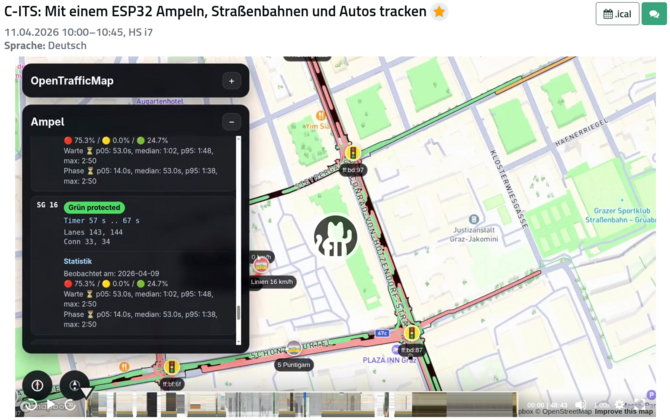
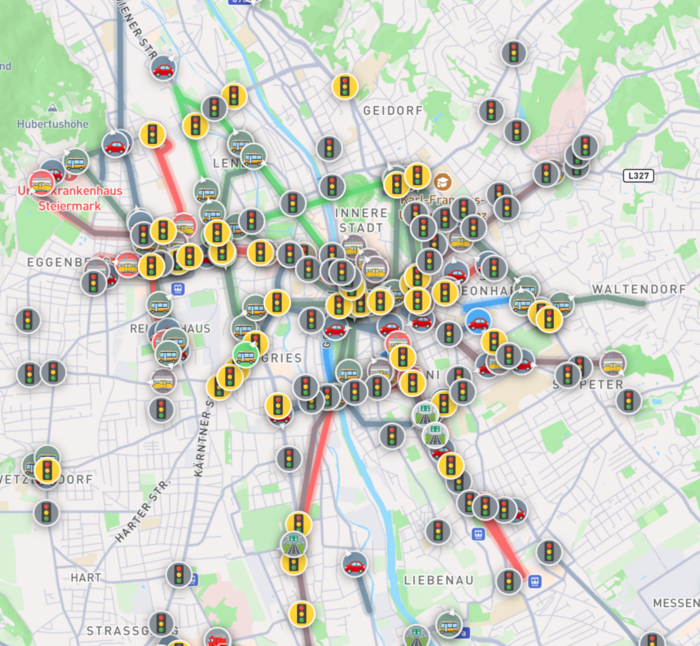
OpenTrafficMap is an open project that visualises C-ITS data — the messages that traffic lights, trams, buses and modern cars already broadcast unencrypted today. Volunteers run small receivers, the receivers report what they hear, and the result is a live map.
Live map: https://opentrafficmap.org
Source code: https://codeberg.org/opentrafficmap
At a glance
| What | Cooperative Intelligent Transport Systems (C-ITS) — see What is C-ITS? |
|---|---|
| Radio | ITS-G5 / IEEE 802.11p, 5.9 GHz, a few hundred metres to a few kilometres range |
| Privacy | Messages are sent unencrypted. They can be cryptographically signed, and vehicles use changing pseudonyms. |
| Receiver | ESP32-C5 based, roughly 20 € for the official board including its enclosure |
| Transport | Every receiver publishes to one central MQTT broker — see The OpenTrafficMap server |
| Licence | Wiki content under CC BY-SA 4.0 |
How the data flows
- A receiver picks up raw 802.11p frames on 5.9 GHz.
- It publishes each frame to the central MQTT broker, unmodified.
- The backend decodes the frames and feeds the live map.
Every receiver project uses the same broker and the same wire format, so it does not matter which hardware you build — the data arrives the same way.
Running a receiver
C-ITS only travels a few hundred metres to a few kilometres, so the map can only show live data where somebody has a receiver nearby. This is the most useful thing you can contribute.
There are two routes:
- The official receiver — a purpose-built board with Ethernet, Power over Ethernet and a weatherproof enclosure. Available through the group order, or you can have the PCB manufactured yourself. See The official receiver.
- Build your own — several independent projects turn an ESP32-C5 development board, or even an old router, into a receiver. See Other receiver projects.
Once it runs, placement matters more than anything else, and the self-service portal lets you name your node and put it on the map.
Documentation
- What is C-ITS? — the technology, and the message types
- Senders — which vehicles and which infrastructure actually transmit
- Coverage — where C-ITS is live, by region
- Receivers — the official receiver and all alternative projects
- Placement & Outdoor — mounting, interference, antennas, weatherproofing
- Your Node — the self-service portal for your own receiver: name, map position, settings
- The OpenTrafficMap server — sending your data there, and reading it back
- Community — contributing, the organization, how to help
- Common questions — an index pointing into the pages above